
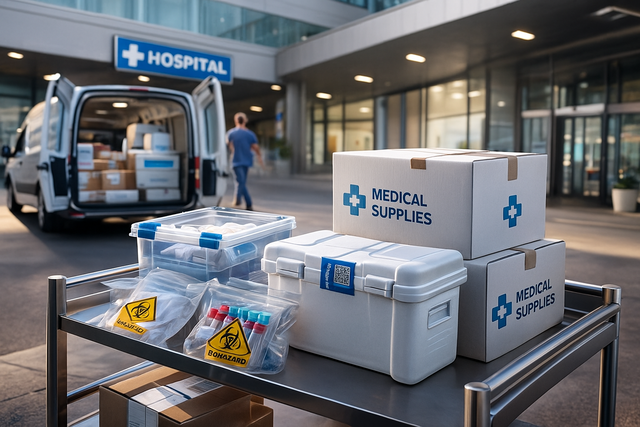
How Healthcare Facilities Can Avoid Compliance Risks in Package Transport
When you’re in charge of any kind of a medical facility, there is certainly no doubt that you will be cooperating with other professionals in order to ensure the smoothness of operations, as well as to improve patient care. And, while I am talking about, say, labs, and other medical pros, the truth is that I am also hinting at professionals that may not be working in healthcare directly, but that could play a huge role in all of this, such as, for instance, medical couriers. But, we will get to that later.
Read about how to store and transport sensitive pharmaceutical products: https://www.who.int/docs/default-source/medicines/norms-and-standards/guidelines/distribution/trs961-annex9-modelguidanceforstoragetransport.pdf?sfvrsn=b80e925f_2
Anyway, to successfully cooperate with any of those partners you have, and to, thus, improve patient care, you will need to move certain packages from time to time among facilities. For instance, you may have to send those blood samples to a lab, and you need to ensure that it is done on time and safely. I am sure you understand the importance of safe and timely transport already.
What you may not be sure about, though, is how to actually avoid certain compliance risks during transport. After all, you are sending medical samples and sensitive materials and products, and you undeniably need to stay in compliance when doing that. The costs of non-compliance can be huge, both in terms of fines, and in terms of reputational damage, or even loss of accreditation. So, time to help you understand how to avoid those compliance risks.
Have a Comprehensive Compliance Policy in Place
It all begins with a good compliance policy. So, establish a comprehensive one, covering step by step procedures for all the material categories, specifying reference to those important regulatory standards, such as HIPAA, DOT and IATA. And, of course, define all the roles and the responsibilities for everyone involved in the transportation process.
Train Your Staff
Okay, defining those roles is one thing. But, making sure that your employees know what they are doing is a completely different thing. Meaning, thus, that you should take your time to properly train the staff, and ensure that they go through certified training on hazardous material handling, biohazard safety and spill response, as well as patient data security. That is, on DOT/IATA, OSHA and HIPAA standards.
Partner Up With the Right Companies
Of course, you will also have to partner up with the right delivery professionals in order to be able to do all of this successfully and remain compliant. And, when you click here, you will understand that there are specific companies that offer reliable delivery services to hospitals, pharmacies, and medical organizations in general. So, your task is to choose one of those firms, and not just any delivery company that comes your way, without having any kind of knowledge on handling medical packages and remaining compliant.
Choose Reliable Ones With Previous Medical Package Transport Experience
The above brings us to the next thing you have to do in order to avoid compliance risks. As mentioned above, you have to carefully choose the company that will complete the deliveries for you. And, of course, the trick is for you to choose reliable ones that have previous experience when it comes to transporting medical packages.
So, take some time to check the experience on their official websites, or inquire about it directly. Then, remember to also check their reputation, through reading some reviews written by previous clients. This is sure to help you ultimately choose highly reliable and experienced pros that will do great work for you, so don’t forget to check those things.
Check Driver Training and Compliance
Just like your staff has to be properly trained, so does the staff of the delivery company you are choosing. So, check whether their drivers go through the necessary training and thus know how to follow those regulatory rules and requirements, and thus remain in compliance with HIPAA, OSHA, as well as PHI standards. Most likely, you will get to find the info about this on the official sites of the companies you are considering, but if not, you can always inquire about it directly.
Meet the Packaging Standards
Inefficient healthcare logistics and non-compliance risks begin before sending out the packages. There is also, well, the packaging process. So, what you have to do in order to reduce compliance risks is use the right and approved packaging and labeling materials that meet the necessary standards for biological substances.
Don’t Forget Chain of Custody
Finally, you shouldn’t forget chain of custody. Everything should be clearly documented regarding who picked up the samples, who transported them, who received them, and anything in between. Real time tracking, automatic alerts for temperature deviations, digital signatures at every transfer point… Those are sure to help you remain compliant as well.
About The Author
