
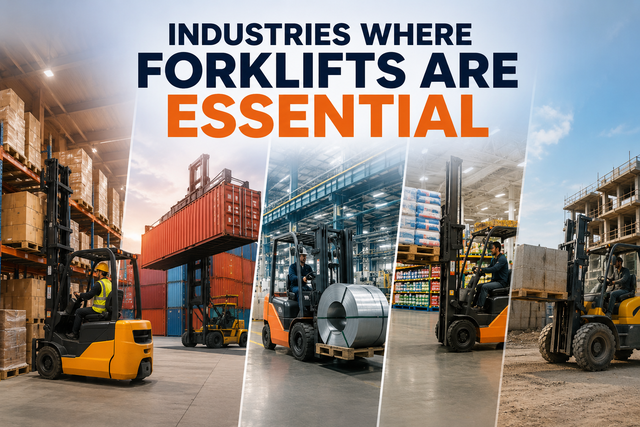
6 Industries Where Forklifts Are Essential
From towering warehouse shelves to sprawling construction sites, forklifts are one of the most indispensable pieces of equipment in the modern working world. Yet for most people, they remain invisible — quietly powering the supply chains and logistics networks that keep economies moving. Whether owned outright or sourced through forklift hire, these machines are the backbone of countless industries. Here’s a look at the sectors where forklifts aren’t just useful — they’re absolutely essential.
Warehousing and Logistics
This is the industry most people associate with forklifts, and for good reason. Modern warehouses are vertical by design, with racking systems that can reach heights of 10 meters or more. Forklifts — particularly reach trucks and order pickers — are the only practical way to move palletized goods at that scale and speed. As e-commerce continues to grow and consumer expectations for fast delivery intensify, the demand for forklifts in this sector has never been higher.
Manufacturing
On the factory floor, forklifts serve a dual purpose: moving raw materials into production and transporting finished goods out. In automotive, electronics, and heavy equipment manufacturing, components are often bulky, heavy, and awkward to handle manually. Forklifts keep production lines running smoothly by ensuring materials arrive where they’re needed, when they’re needed. Downtime caused by a lack of material handling equipment can cost manufacturers thousands per hour, which is why many facilities rely on forklift hire to cover peak periods or planned maintenance windows.
Construction
Construction sites deal with heavy, irregular loads that no team of workers could shift safely on their own — steel beams, concrete blocks, roofing materials, and large equipment. Rough terrain forklifts and telehandlers are built specifically for the uneven ground and variable conditions of a building site. Because construction projects are temporary by nature, forklift hire is often the most practical and cost-effective option rather than purchasing equipment outright.
Retail and Wholesale Distribution
Behind every large retailer is a distribution operation that relies heavily on forklifts. Supermarket chains, furniture retailers, and wholesale suppliers all move products in pallet quantities — a job that would be impossible without powered lifting equipment. Loading bays, stockrooms, and distribution hubs all depend on forklifts to receive deliveries, organize stock, and dispatch orders efficiently.
Agriculture
Farming may not be the first industry that comes to mind, but forklifts and telehandlers play a vital role in agricultural operations. Moving large bales of hay, loading and unloading produce, and shifting heavy bags of fertilizer or feed are daily tasks on working farms. Specialized attachments make forklifts adaptable to the unique demands of agricultural environments.
Ports and Freight
Shipping ports are among the most forklift-intensive environments on earth. Containers, cargo pallets, and heavy freight must be moved constantly and quickly to keep terminals operating efficiently. Large counterbalance forklifts and container handlers are purpose-built for port environments, where precision and load capacity are equally critical.
Conclusion
Forklifts are quietly essential to the infrastructure of modern industry. Whether it’s stacking shelves in a distribution center, keeping a production line fed with raw materials, or moving freight at a busy port, these machines do the heavy lifting — literally — that keeps businesses running. For companies that need flexible access to equipment without the long-term cost of ownership, forklift hire offers a practical solution that scales with demand. Across every sector, one thing is clear: where there are heavy loads and tight timelines, forklifts will always have a role to play.
About The Author
