
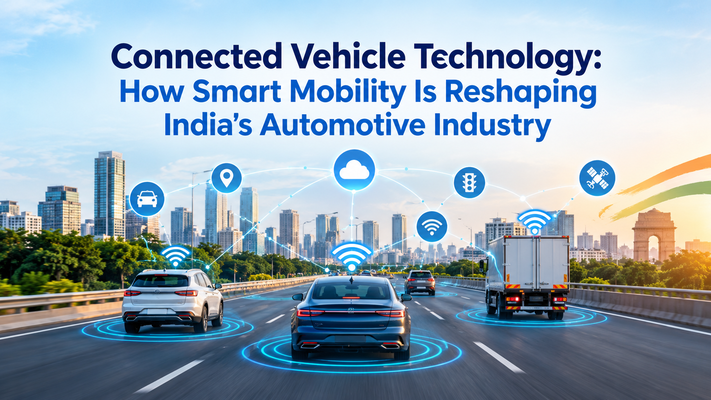
Connected Vehicle Technology: How Smart Mobility Is Reshaping India’s Automotive Industry
Connected technologies are increasingly being embraced by the automotive sector of India. These technologies facilitate the sharing of data between vehicles, drivers, manufacturers, service stations and road infrastructure. Connected vehicle technology uses a combination of sensors, telematics control units, Global Navigation Satellite System (GNSS) coordinating system, cellular networks, cloud computing and software. The applications for connected vehicle technology include monitoring in real-time, predictive maintenance, navigation and management of fleets.
The report by DataIntelo’s has revealed that the global connected vehicle technology industry was valued at $96.8 billion in 2025, and according to the projections, it is likely to reach a value of $316.7 billion till 2034 with a CAGR of 14.2% from the year 2026 to 2034. The emergence of connected vehicle technology is an indication of the growing demand for connected mobility solutions, vehicle telematics, advanced driver assistance systems, and automotive solutions based on data.
From Connected Cars to Connected Mobility
The process of collecting signals from components like the engine, brakes, battery, and sensors related to driver-assistance is performed by electronic control units (ECUs). Via the use of a telematics control unit, a specific amount of information is sorted out from various sources and sent through the mobile network to a cloud platform for analytics purposes. Reliability, security of authentication, and guidelines concerning data access are important for every step of the process.
According to the data presented by the government’s Parivahan Analytics portal, there are around 24.93 crore active registered vehicles in Vahan registry. Nevertheless, it should be remembered that this is not a number of connected vehicles but a number demonstrating how vast the transport ecosystem is.
The Technology Stack Behind Smart Mobility
Connected mobility relies on the integration of multiple technologies, including:
- Sensors and ECUs that assess speed, temperature, battery status, performance of the engine and functionality of safety systems.
- GNSS and mapping determine where the vehicle is, which direction it moves in and where the route goes.
- Cellular communication that allows to provide up-to-date information about traffic or perform diagnoses. 4G systems can provide many services while 5G has bigger capacity and less delays.
- V2X is used for sharing information between vehicles, road signs, and pedestrians.
- Cloud analysis and AI allow to study the movement patterns of the fleet, detect any unusual information and plan maintenance work.
- Cybersecurity ensures reliable communication channels.
Safety Moves from Reaction to Warning
The interconnected systems can furnish data more than what the driver thinks. Vehicle-to-vehicle communication is capable of transmission including speed, location and warnings on braking. Vehicle-to-infrastructure communications are able to transmit and relay information on signal timing, road construction, and other dangers on the road. With a timely message, the driver or the compatible vehicle system can have more time to react.
The Ministry of Road Transport and Highways of India describes the proposed vehicle-to-vehicle framework making use of the 5.875-5.925 GHz frequency band and the Cellular Vehicle-to-Everything (C-V2X) technology. The draft proposal establishes the workings of some features of the V2V technology, including emergency brake alert/forward collision warning, wrong-way driving alerts, and emergency vehicle alert. Since this is a draft proposal, it cannot be seen as a final requirement or law.
Fleet Management Becomes Data-Led
Fleet managers can analyze route compliance, idling time, consumption of fuel or energy, behavior of drivers and maintenance notifications among fleets. Geofencing technology manages to notify dispatchers when a vehicle enters a delivery area, while the analysis of the route can reveal patterns of delay in transportation. As for the alerts from diagnostic services, they allow workshops to catch any suspicious behavior of temperature notifications or battery performance before it’s too late.
Fleets can keep track of their mileage per liter, energy expenses per kilometer, timeliness of delivery, time spent idling and repair required (planned and unplanned) before and after launch. The fleet of 100 vehicles could be used as a good pilot project for analyzing the mentioned indicators in 90 days after being launched.
Predictive Maintenance and Remote Software Updates
Diagnostic tools provide important operational parameters, such as faults, temperature trends and usage of parts. Software can notify vehicle owners when certain criteria are met, so that automotive technicians can see diagnostic reports before the vehicle arrives at a workshop. Such value is depending on the quality of sensors and accuracy of alerts.
The OTA (over the air) updates enable manufacturers to make changes to their software without having to go through the entire process in a repair hub, although the updates should contain such features as signing, checking for compatibility, providing enough power and having suitable ones for communicating the updates to customers.
Connected Mobility Applications
| Technology | Data or connection | Practical use |
| Telematics | Location and diagnostic data | Fleet visibility and service alerts |
| V2V / V2X | Messages between compatible systems | Collision and hazard warnings |
| AI analytics | Vehicle and fleet patterns | Maintenance prioritisation |
| OTA software | Authenticated update packages | Remote software improvements |
| EV connectivity | Battery and charging data | Charging and route planning |
Electric Vehicles Need Connected Data
Electric vehicle data includes information on battery temperature, current state of charge, charging performance, and information regarding the consumption of power. The interconnection facilitates the search for charging stations and charging management. Fleet managers are able to create charging schedules and calculate energy consumption in different routes for comparison purposes. The indicators to be used include total energy consumption in one kilometer, the duration of charging sessions, availability of chargers at certain places, and travels lost due to charging limitations.
The vehicle should maintain the basic capability to drive even without network access, however, it should record the necessary information and upload it later on.
Cybersecurity and Privacy Are Essential
An increase in connectivity leads to greater need for security measures in different areas. Security threats range from credential theft, insecure mobile apps, and insecure third-party software to unauthorized access to vehicle databases. Strong designs involve splitting critical control network systems from infotainment networks as well as restricting their access rights, encrypting sensitive information, and monitoring security events. In addition, manufacturers should provide vulnerability reporting, patching and incident response processes for their vehicles.
What India’s Automotive Industry Should Prioritise
Industry participants should:
- Employ interoperable standards in order to allow hardware from various manufacturers to share similar messages.
- Plan for Indian conditions including hot climate, dust, vibration, mixed traffic and sporadic network signal.
- Carefully test before launch and be prepared with monitoring measures for performance in safety, availability, expenditures and customer satisfaction.
- Conduct a full cycle of activities from production and software supplying to updating and discontinuation.
- Train maintenance personnel in diagnostics and software checks of performance.
- Ensure that customer understands business advantages of the technology such as notifications, safety alerts, fleet operations.
The Road Ahead
Connected vehicle technology enables vehicles to communicate with software, cloud analytics and external transport environment. The market is estimated at $96.8 billion in 2025 and at $316.7 billion by 2034 globally, indicating the magnitude of this transformation. The active registered vehicle count in the country is approximately 24.93 crore, which denotes how extensive the transport ecosystem is. Advancement in this sphere would largely depend on the existence of reliable networks, corresponding standards, information security, ethical data usage and evidence-based implementation of connected technologies in India’s automotive sector.
About The Author
